They say if you spend enough time in the field, your instincts sharpen before your tools do. After 25 years chasing leaks across Alberta’s oil and gas facilities, I’d say that’s about right. I’ve stood on frostbitten steel catwalks, hands wrapped around a thermal camera, watching invisible hydrocarbons dance in the cold air—reminders that what we can’t see often costs us the most.
Fugitive emissions aren’t just a regulatory checkbox. They’re operational liabilities, safety concerns, and—when managed right—real financial opportunities. Especially here in Alberta, where the regulatory framework has matured to the point that leak detection and repair (LDAR) can be more than a compliance measure—it can be a revenue stream.
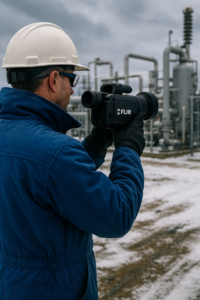
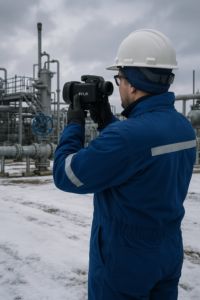 My earliest LDAR days were all about AVO—audio, visual, olfactory inspections. You’d listen for hissing, watch for frost patterns, or catch a faint whiff of gas and log it. That was the norm, and to be fair, it still has its place in the toolkit. But the game changed when we started integrating optical gas imaging. Suddenly, we weren’t guessing. We could see the leaks—live, in motion, in conditions where AVO would fail you every time.
One winter near Fox Creek, I was called out to a facility with persistent line losses no one could trace. Sub-zero temperatures, compressors cycling, no obvious signs. Using an OGI camera, I spotted a leak on a vertical flange, high up and out of the normal AVO zone. It had likely been venting for months. That one detection saved them tens of thousands—not just in product, but in avoided non-compliance. Moments like that change how you think about fieldwork.
More recently, the spotlight’s shifted toward Compressor Seal Vent (CSV) testing. It’s no longer a “nice-to-have.” With the AER’s April 2025 update to Directive 060—Bulletin 2025-15—the province doubled down on expectations for Fugitive Emission Management Programs (FEMPs), especially around alternative pathways. That means operators can no longer rely on generic plans or assumptions. Your data has to be clean, structured, and defensible.
And CSVs are often where the credits come into play. Alberta’s TIER program, paired with its serialized offset credit market, gives real financial weight to emissions reductions. When you can prove that you’ve eliminated or captured a vent source—whether it’s from a rod packing seal or an old bleed-off valve—you’re not just avoiding penalties. You’re potentially banking offset credits with real market value. I’ve helped operators turn those reductions into tangible gains, sometimes amounting to six-figure returns.
But that only happens when the data stands up to scrutiny. I’ve seen promising credit projects fall apart because flow calculations weren’t defensible or maintenance logs were incomplete. It’s not about volume—it’s about verification. A simple CSV test, done right, can mean more than a complex vent capture system with missing documentation.
 And here’s something that gets overlooked in a lot of LDAR strategies: site culture. The best tech in the world doesn’t matter if the team in the field doesn’t buy in. I’ve worked on sites where techs would rush through inspections to get back to scheduled work, not realizing they were bypassing potential emissions points. I’ve also worked with operators who built emissions accountability into their daily routine—those are the sites that pass audits, reduce fines, and unlock carbon value.
Another lesson? Coordination is king. Emissions testing, engine checks, measurement verification—when these are done in isolation, you burn hours and budget. But with proper planning, a single mobilization can cover LDAR, MSAPR, CSVs, and even vent quantification. It’s not just operational efficiency—it’s regulatory foresight. That’s what gets noticed during EPAP reviews and site inspections.
Now, not every province offers the same opportunities. Saskatchewan and BC have their own frameworks, but when it comes to carbon offsets, Alberta is where the playbook really comes together. The TIER program isn’t just about compliance—it’s about strategy. You reduce emissions, document them right, and suddenly you’re holding assets. And in a market where margin matters, those assets count.
I once worked with an operator who had a dozen scattered sites and no unified emissions approach. They were good people, but stretched thin. We implemented a full LDAR plan—customized FEMP, regular CSV testing, quantification built into every report. By year two, they weren’t just compliant—they were offset-positive. They didn’t grow their footprint, but they increased their asset value. That’s what happens when field strategy and regulatory awareness line up.
So no, LDAR isn’t just about finding leaks. It’s about building programs that don’t just pass audits—they generate revenue, reduce risk, and make field crews part of something bigger than compliance.
That’s what keeps me going. Not the tech, not the credits—the shift in mindset. Helping operators see emissions not as a problem to hide, but a performance metric to manage.
These days, I spend less time explaining why emissions matter and more time showing people where the opportunities are buried—often in the quiet, overlooked corners of a site. It’s not about chasing leaks anymore. It’s about creating systems that work even when we’re not watching. And that’s the kind of impact I’m proud to leave behind.
 Another widespread misunderstanding is that SCADA is costly and requires extensive upkeep.
 It is fairly obscure outside the sector but energy rates and efficiency can be boosted and the reality is that is the primary challenge for just about any energy solutions company.
  Field energy services organizations offer a wide array of service like meter proving, sampling and analysis, electrical and instrumentation, construction, automation and controls and even software solutions. Overall though we’re on the cusp of a paradigm shift within this sector due largely in part to the pandemic that has gripped the world over the past 6 months.